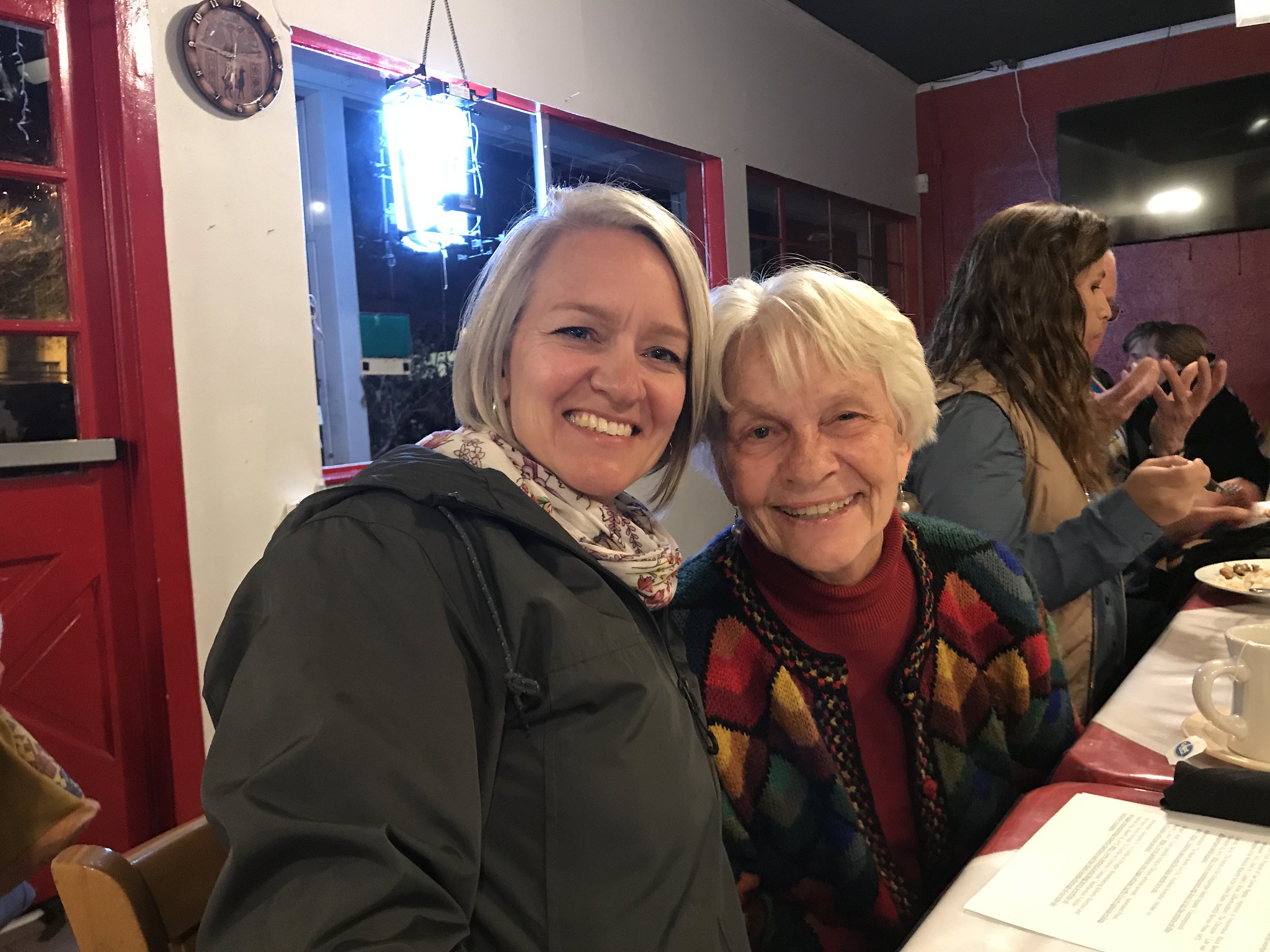
My mom has been with Jesus for 3 years now. Hard to believe. I don’t have a whole lot to say about it, but wanted to share some pictures of her because she was amazing, had an gorgeous smile, and we miss her.
Mom and Dad. 63 years of wedded bliss.
My mom and me. Just us. Yes the last pic in this gallery is me at 16 or something.
Mom with her grandchildren. She loved every one of them and gave them all so much.
My mom was a real firecracker. This must have been in the mid 80s, we were at a family reunion and she got out there skiing. When I was growing up, I wouldn’t have described her as an athlete, but in her heart she was. She would randomly surprise us with her athleticism.
Mom with her sisters. She loved her people, and they loved her right back.
Mom teaching and playing music. She was happiest with an instrument nearby and someone to play with.
It rained for what felt like weeks in New Mexico. Now, in the first weeks of October (how is it the first week of October already) NM is showing off in true classic form. The weather is brilliant and perfect:
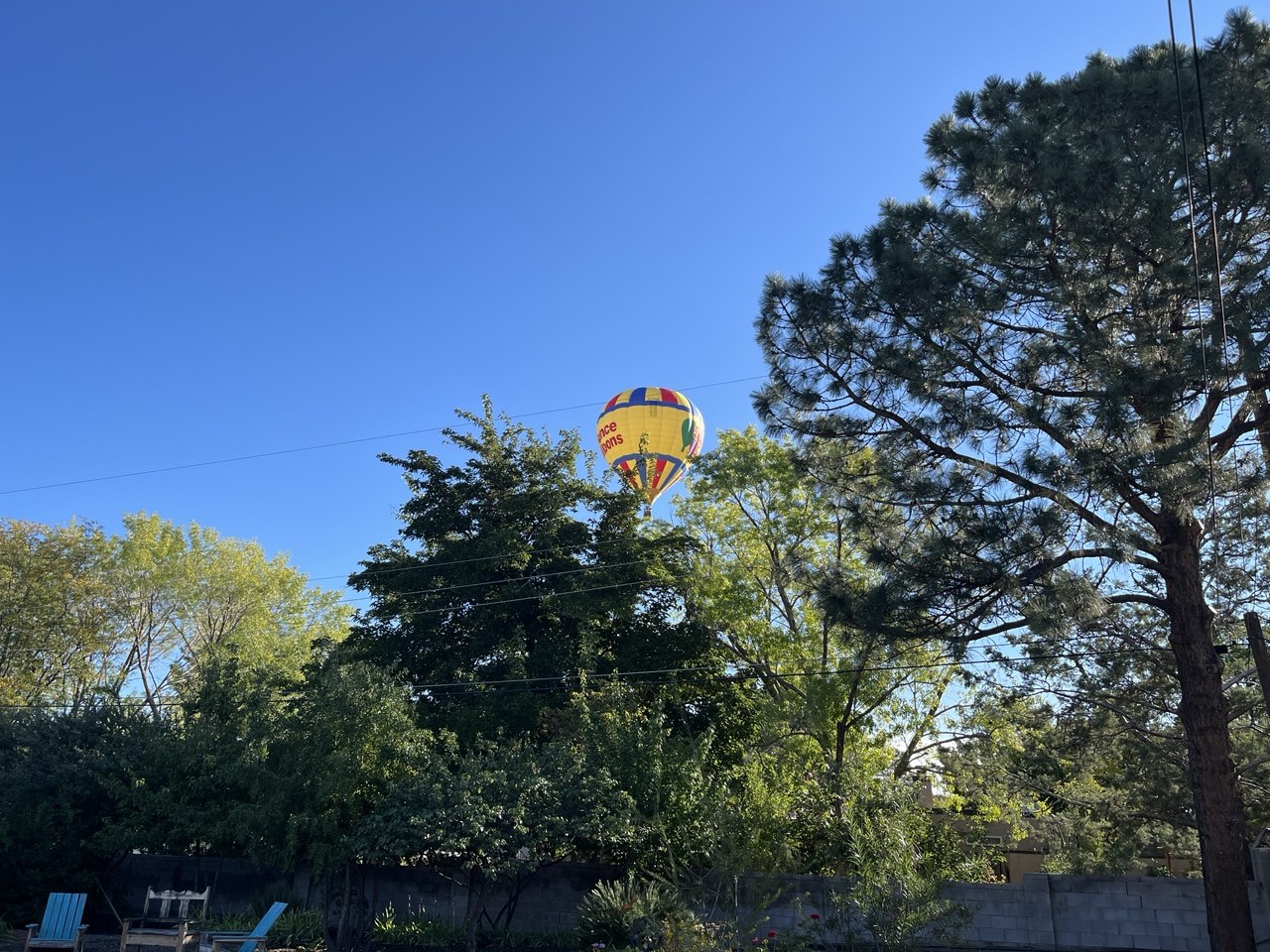
On the first day of the International Balloon Fiesta, always in October, a balloon glided over our house. This is rare, as we are very close to the military base and balloonists tend to avoid the hassle of landing on base. It’s such a treat though when it does happen. This morning we heard the unmistakable darth vadar breathing of the balloon’s propane tank.
We grabbed our shoes and went running to see it land. Alas it did land on the base but it was a good viewing. Pretty sure the pilot tried valiantly to land at the greenway just before the base fencing, but what with power lines, I’m guessing it was iffy.
We saw them come down just past the fence.
After 20 years in Albuquerque it still doesn’t ever get old.
A few weeks ago I got a few short minutes to talk to my colleagues about getting involved in the WordPress community. We usually talk about product and all that good stuff, and that matters. But at the end of the day, the community is the thing underneath all of it.
WordPress runs a big slice of the internet. That is all software. But it is also people. It can’t happen without people. Someone translates strings so WordPress can be used in their country. Someone taught a room of kids how to build an app with it. Someone went to a coworking session in their town and learned how to publish their first post. Someone started a club at their university so students could learn to build in the open. Someone coded a plugin with Claude to add the one feature their site really needed.
That said, a lot can be done with AI now. I built a database for a talent organization I love so they could keep better track of the vendors and tools they rely on. I used Claude and it was genuinely cool. That database took me a weekend instead of months. What Claude couldn’t supply was caring about the org in the first place. Matt said the other day that AI is going to take over the drudgery, and what is left is the stuff that is actually fun. A bot can’t host a meetup or a WordCamp, he said. It can help you organize one, keep track of the details, plan it more efficiently. It might help you contribute better, but you still have to be the one who shows up at contributor day. It is not going to get excited about a weird problem, or come up with the weird problem in the first place. More people are going to build more things faster now, and plenty of them will land in WordPress without knowing there is a community attached to it. Meetups are how they find out.
At work we have been reading Getting Real, the Basecamp book. It is mostly about software, but really it is about building something real. And a meetup of people talking about WordPress is the most real thing in the whole ecosystem, outside of the actual software people build. And that is people too.
I just came back from WordCamp US 2026 in Phoenix. What a delight to be around people in person, just being people together, celebrating and building the software, making human connections, evangelizing the community.
Which brings me to you. If you have ever gotten anything out of WordPress, and most of the web has, there is probably a meetup near you (and if there isn’t, you should start one). It might be small. It might be a little awkward the first time. Go anyway. Show up once. That is how every one of these rooms started, with one more person deciding to walk in.
My current work involves a lot of context switching and incorparates a bunch of incoming information everyday: two Slack workspaces, email, calendar, internal P2s (blogs), and meetings. The most fragile piece in this chain is me. It’s a lot to keep up and and if I’m relying on me retyping it into a tracker or writing it into a task list, context is lost and relies on just me and my brain.
My brain is pretty useful, but if you add in my non-work obligations, there is a lot of space for human error.
I’d been using Claude in chat and Cowork to think through problems. It’s useful, but everything goes in one direction with me asking and Claude answering. What I needed was something that did the looking for me and helped me prioritize.
So I opened Claude Code for the first time.
And what ensued was a personal operations system that lives on my laptop built through conversations and no code I wrote myself.
Piece
What it does
Obsidian vault
Single source of truth: TASKS.md, a memory file Claude maintains, rolling files for ideas / strategy / brainstorming captured from meetings.
Morning scan
Runs at 8:30 AM. Pulls Quill meeting transcripts, Slack mentions and self-DMs, Gmail for-Claude items, a curated set of internal P2 posts. Extracts tasks, projects, ideas, strategy.
Daily digest
Calendar, FYI items, stats, status. All written each morning, rendered at the top of the dashboard.
Web app
Localhost dashboard, two columns: actionable on the left, awareness on the right.
Watcher
Confirms the scan ran. If it didn’t, triggers a recovery agent so I always have a fresh queue by 10 AM.
Weekly drafts
Monday “what I’m working on” and Friday “what I shipped” posts for our cross-team thread.
Delegation
Helps me track what I have delegated to others, from the dashboard.
Every task has buttons for pin, mark urgent, mark done, move to another section, delegate. Each click rewrites the source markdown directly.
I started with just the vaguest idea, I was looking to Claude Code to help me diagnose and plan. From there, each addition came from a frustration or a gap I noticed:
Markdown task list, sectioned by strategic priority.
Morning scan ingesting four sources, writing a queue.
Auto-archive of ticked items into a dated Done section.
Web app, so I could see everything without opening Obsidian.
Watcher to catch silent failures of the scan.
Per-section quick-add for inline capture.
Section moves and delegation from the dashboard.
Mobile access via Tailscale.
The first iteration was just an .md file in Claude. I had to tell Claude when I checked something off. Then we moved to Obsidian because that gave me a surface I could actually interact with and actually check things off my list. Then we moved to a browser page that does all the thinking so any action I take on the page is updated in the tool.
The most recent addition was that I realized I could be looking at this on my phone, which is sometimes less distracting since I wouldn’t have other things going on in the background. I had no idea how to accomplish this so I asked Claude and it gave me a suggestion to set up Tailscale — a free private mesh network that lets my own devices reach each other. Now the dashboard loads on my phone from a saved icon on my home screen. Amazing!
I didn’t write code. I described what I wanted and Claude built it. I said what felt wrong and Claude adjusted. When something broke, I described the symptom and Claude diagnosed. Amazing!
I was scrolling through pictures from a recent visit to South Padre Island in Texas and apparently I got the neatest shot of a heron flying into the sunset.
We were walking around on a rock wall and I saw this guy in the distance and started clicking shots in case it flew off before I got closer. Here’s the play by play:
I first heard about the Johari window on Smarter Every Day, Destin Sandlin’s YouTube channel. What intrigues me about it is how it forces you to remember that even though we live inside our own skin and our own brain every day, we don’t actually know everything about ourselves. Sometimes other people can see things more clearly than we can.
A visual representation of the Johari Window diagram illustrating self and others’ awareness.
The hard part is that it’s genuinely difficult for people to be honest with you about what they see in you that you don’t see in yourself. I can count on one hand the people in my life who I can really hear that kind of feedback from non-defensively, and unsurprisingly, those same people are the ones I can return the favor to. That kind of trust requires trust in both directions.
I spent some time talking to Claude about the “known to self / not known to others” quadrant because I was a bit fuzzy on it. They call it the facade, and I thought it was more about putting on a fake front, but then I realized it’s about the stuff you know about yourself and choose not to share. Private thoughts, fears, opinions, the interior life that we keep to ourselves. So, we can grow the “known to self/known to others” quadrant in two directions. Others tell you what they see (telling you what you don’t know), and you tell others what you know about yourself (helping them understand you more).
Which got me thinking: Claude probably knows more about me at this point than almost anyone else. I use it every day at work for thought processing, drafting, organizing messy information, and working through decisions before I land on them. And on the personal side, I use it for volunteer board minutes, sympathy notes, travel planning, even sorting through my watercolor strategy. I’m trusting by nature, so I suspect I shrink that facade quadrant more than most people do, at least with a really smart computer that isn’t going to judge me. Unless that’s something that sits in the known to others and not known to me‽
It raises a strange question the original Johari window never had to answer: does an AI count as “others”? Pretty sure it doesn’t. But it’s an interesting thought exercise and made me think about what disclosure is actually for. That act of putting something into words, to someone who listens, is how you start to see it more clearly yourself.
Then there’s that whole fourth quadrant: the unknown unknowns. The stuff you don’t know about yourself and no one else knows either. Destin thinks that’s the territory God knows, and as a Christian I agree. I keep trying to think of what might be in that box, but I guess that’s the point. If I knew, it wouldn’t be unknown. The best we can do is hope that anything in there will be revealed in time.
I’ve been thinking about this in my work too. Turns out, communities have Johari windows too. The only way to shrink those areas which others know and you don’t is to have people you trust enough to tell you what they see. And maybe the facade matters there too: communities only really open up when the people in them feel safe enough to say what they actually think.
Being new to the the Automattic .Org team meant WordCamp Asia was an extension of my onboarding: a chance to rediscover everything WordCamp, reconnect with the community, and meet the people behind the projects.
I flew in ready to help staff the Career Corner booth alongside my colleague Pam Kocke from the Talent team, and pitch in wherever I could with the organizing team. And I left with my Notes app full of ideas and so much energy from being around thousands of people who love what they do.
Pam at our cute little Career Corner booth.
WordCamp Asia 2026 was huge! Final ticket sales landed at 2,645, with 2,285 attendees actually walking the floor. It was a reminder of how big and alive the WordPress community is across the region. The official WCAsia 2026 wrap-up post has the full recap if you want to know more.
The moment that sticks with me: two girls from YouthCamp came by with their mom and asked some of the sharpest questions I’ve heard about building a future around WordPress. They wanted to know how to engage with WordPress as a product so that they could be in the community and eventually be contributors. Young community members, growing up inside the project. So cool to see.
A few other standout moments, all of which should be findable on the official schedule:
Mahangu’s data talk — a clear-eyed look at what the numbers are actually telling us about the ecosystem.
Maciej’s education panel — our team’s contribution to the conversation about how WordPress shows up in schools and universities. We signed on to the WP Credits contract with a cohort of 16 universities across India — another step for how WordPress shows up in formal education. More on the broader education initiatives is being tracked on make.WordPress.org.
Mary’s AMA — candid, genuine, and exactly what an AMA should be. When Matt came down sick, Mary also stepped in and pulled together the final talk on short notice. It was a reminder of how much this community runs on people being willing to pick up the slack for each other.
The event itself was pleasing to the eye in a way that matters more than people give it credit for. The venue was great, the signage was thoughtful and lovely, and the overall production made it easy to focus on the people and the content instead of logistics.
I will not soon forget the handful of terrifying-close-call moments with cars and tuk-tuks. If you’re headed to Mumbai for the first time, know that crossing the street is its own activity. I survived, mostly through the grace of people more experienced than me yanking me back onto the curb.
I came to WordCamp Asia as someone new to the team and I left it feeling like I’d stepped into something bigger than a job. The community showed up: curious kids, seasoned contributors, educators, plugin legends, and organizers who made the whole thing look effortless (it wasn’t). I’m already looking forward to the next one.
And in case you missed it: WordCamp India has been announced as a new flagship event. Looking forward to it!
After 13 years working on hiring workflows and Talent Acquisition at Automattic, I’ve made a career switch. Not to a new company, but a new chapter inside the same one. I spent the last several years building Automattic’s global Talent function with a lot of iteration, a lot of learning, and a team I genuinely loved working with. It wasn’t always easy and it wasn’t always glamorous, and we had our moments of stress and frustration, but it was meaningful. The experience of growing that function, supported by first our CFO, and then our CPO, from nothing into something real and lasting is one of the things I’ll carry with me. I’m really proud of it.
But over time, I realized I was craving a new challenge. And at just the right time, an opportunity came across my path.
I’ve moved over to the division that we call .Organization. It’s the group that works to connect product, community, and education, ensuring that WordPress continues to grow as a durable infrastructure for the open web. It’s essentially coming back to my roots. I co-founded the Albuquerque WordPress meetup in 2010. I co-organized the first WordCamp Albuquerque. The WordPress open source community is literally how I found Automattic in the first place.
I’m aware that not everyone works somewhere that says, “Hey! after more than a decade of building something in one area, what else might you be great at?” That’s the kind of company Automattic is, and I don’t take it for granted for even a second.
I’m stepping into this new role with a lot of humility. The WordPress community has been through a lot. Primarily I’ll be focusing on operations and events and bridging any gaps between Automattic and the community. People will see me at WordCamps and local meetups for now and around the Make Slack. Right now, the team I’m working with is finding and implementing ways for students in the education programs to get integrated into the community as contributors. This is pretty exciting as we are working on real tangible ways of building and future-proofing the community. I care about this community deeply and I want to help make things work well for the people in it and help make sure it’s around for the long haul.
A few weeks ago, our CEO encouraged us all to get out and visit a museum in our local area. As a long-time home-office worker, I do find that I don’t really get out much! So this was a fun assignment.
I went over the the Museum of ABQ which houses exactly ONE Georgia O’Keefe, which is annoying seeing as how she spent a lot of time here and painted so much of New Mexico. I believe the one they have in the museum is the first painting she did in NM.
The building itself is a work of art, with some lovely indoor patio sculpture areas.
If we are collecting odd and unusual museums, I do want to shout out to the International Rattlesnake Museum, which I will not visit because snakes freak me out, but my family has been there a million times. Pictured below is my mom and me and one of my kiddos circa 2011 just before I started working here in front of the door. Very classic New Mexico vibe.
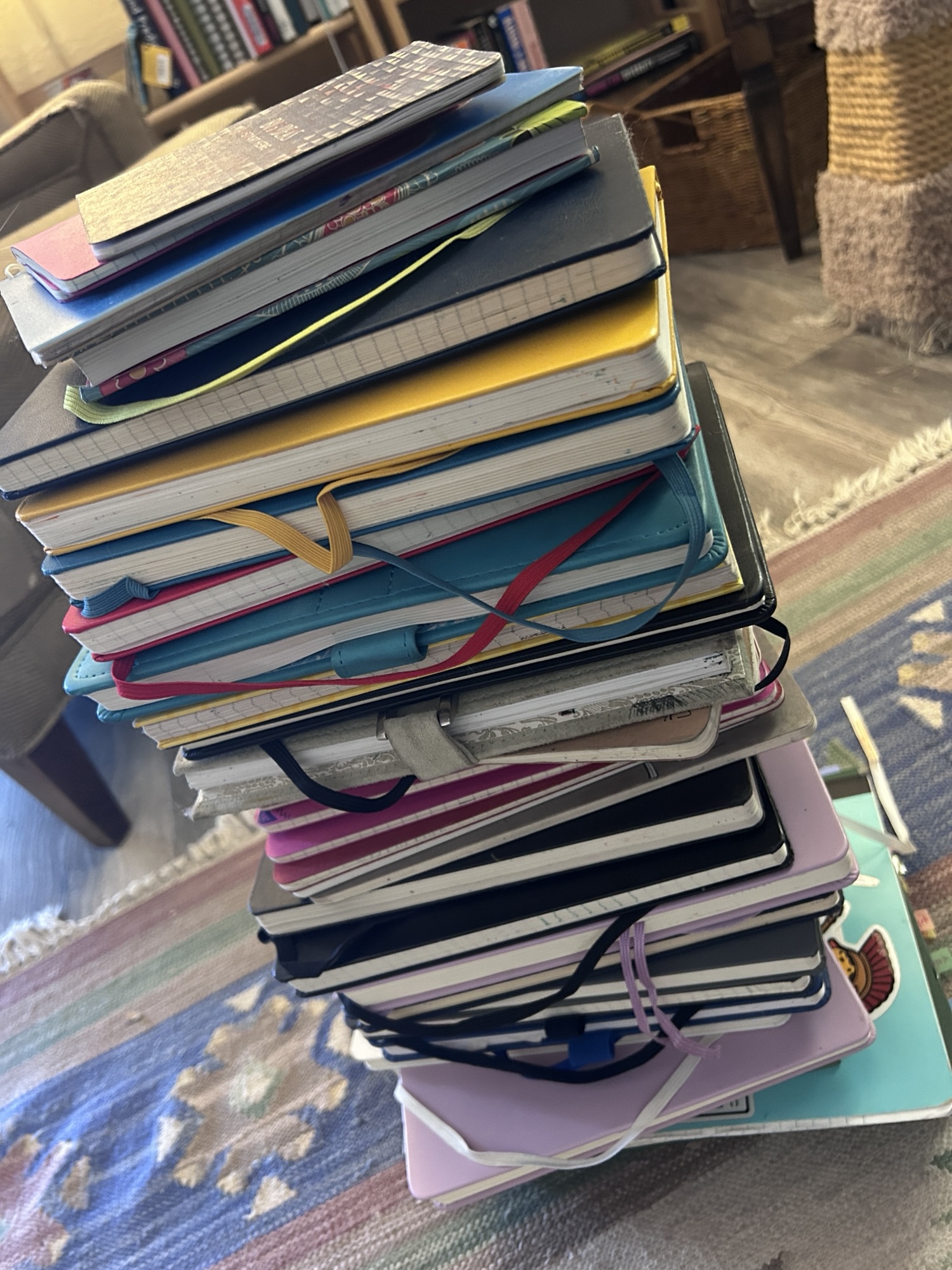
In the spirit of letting go of stuff, I decided that I don’t need to keep all my old work notebooks. I paged through them to make sure I hadn’t stuck any important keep-worthy things in the pages (I had) and stacked them up to memorialize them in pictures.
They are very cute:
Big ideas!
It’s a bit hard to let them go, I’m not going to lie. But I think it’s ok.
Some things I’ve learned:
It’s ok to not always use my notebooks. It’s not a rule that I must use them. If I’m in a period during which notetaking isn’t helpful that’s fine. I pick it up again when I need it again.
Lined notebooks are way better for me, except that if I’m in a doodling phase, lines are annoying.
Hard cover notebooks are way better.
A good pen that writes nicely is key! Really really key. When I don’t have a good pen, I don’t take good notes.
My handwriting is really getting worse with time. I’m not sure if I care enough to fix that but it’s worth noticing.
I never actually went back to previous notebooks like I thought I would.
Now I have to figure out how to dispose of them! I’m not inclined to just put them in the garbage. As it’s winter here where I live, I might use the pages as fire starters. We shall see; even though I’ve decided to let them go, they haven’t made it out of my room yet 😆 so I guess the story is, as yet, unfinished.
Twenty years. That’s just wild! WordPress (which turned 20 in 2023) came to my awareness in or around 2007. I was a stay-at-home mom, trying to figure out how to contribute to our family income, while maintaining my commitment to homeschooling them. WordPress gave me that! In a very real “this helped us pay our bills” kind of way.
WordPress, and then WordPress.com, changed everything for me. It went from being the platform that helped me contribute to my family’s income to becoming my employer. And the place where I’ve built my career.
And that’s what democratizing the web actually looks like in practice, building something that matters, the ability to earn money, and to ultimately contribute to supporting my family. All backed up by this foundational belief that everyone should have access to their own corner of the web. Gives me goosebumps.
My kids have sported a lot of WordPress, Automattic, and WordPress.com related swag over the years.
My story isn’t unique. There are millions of creators and businesses who’ve built something real on this platform. 409 million people visiting each month. 70 million new posts. These are real people with their own stories about what WordPress.com made possible for them.
So, happy 20th birthday to WordPress.com. Thanks for trusting us with our corners of the web. Thanks for making freedom and ownership actually mean something.
I recently returned from a work trip to London where I tacked on a couple of extra days to explore the city entirely on my own. This is unusual for me and it got me thinking about solitude, community, and how I move through the world.
I never travel alone. I fly solo plenty, but I’m always either meeting colleagues or traveling with family. Even when I’m working “alone” at my desk at home, I’m constantly connected through calls and Slack messages. My distributed company means I work in isolation physically, but I’m never truly alone.
Over my lifetime, I’ve rarely experienced extended periods of complete alone-ness. I lived with my family growing up (youngest of six kids), then had roommates in college, then got married, then I had kids. There was a brief internship when I lived alone for a few months, but even then, I got a dog pretty quickly. I don’t mind this pattern. It’s genuinely how I’m wired. I thrive on connection and collaboration.
What struck me about London was being alone while surrounded by millions of people. I was just one in the crowd, making my way through the city with no one to check in with. This honestly freaked me out a bit. Being in a different time zone. No one immediately aware of my whereabouts. Not my favorite feeling from a safety perspective, so I made sure my family always knew my general plan for the day.
I stayed in a hostel, which possibly was over the top, but essentially the theme of my trip: my own space, but among people. Independent but not isolated. My adorable little coffin capsule is a story for another day.
Traveling with people, especially my husband, brings out something I love about shared experiences. We have different but complementary travel styles. We like similar and distinct things so we complement each other well. The “should we go left or right?” conversations, the shared discoveries is the best part for me.
Without someone to bounce ideas off of I found myself hitting decision fatigue faster. All those small choices that normally get shared or negotiated became exhausting.
But I did enjoy the novelty of having complete autonomy for a day or two, just doing my own thing. I could spend as long as I wanted studying JMW Turner at the Tate. An amazing series of rooms full of his work! I was looking for Sargents and wow, when I saw W. Graham Robertson from 1894 and Ellen Terry as Lady Macbeth from 1889. Goodness! The portrait artist in me just wanted to stand in front of those two for ever. Then I meandered through the Victoria and Albert Museum at my own pace, doubling back to revisit pieces that caught my eye. And getting lost and confused in a way that would have annoyed anyone tagging along with me. Or maybe I wouldn’t have gotten lost. There is a thought!
I walked along Regent’s Canal to check out the narrowboats. I wandered past all the touristy spots, but then veered off into the quieter garden squares that feel like they’re pulled straight from the pages of Jane Austen or Georgette Heyer novels I love.
As much as I enjoyed those solo days, I found myself eager to share my travels when I got home. I found a coffee shop hidden off an alley that I almost didn’t go to, but when I recognized a woman from the hostel heading the same direction, I realized it was probably legit.
The pleasant surprise of seeing the Last Supper (a copy made by Leonardo’s students) at the Royal Academy of Arts. A Degas that caught my eye because it featured the orchestra in the foreground where you could actually see the bassoons clearly. These experiences were meaningless until I could share them with my husband and kids.
Maybe that’s the thing about solitude for me. It’s valuable in small doses, a chance to hear my own thoughts more clearly and move at my own pace. But ultimately, the experiences I treasure most are the ones I can share and the stories that become better in the telling,